
Intermittent nature of solar energy has been one of the major areas of criticism of the nascent energy source especially when contrasted with traditional gas-fired electricity generation. Strictly speaking comparing the costs of gas-fired vs. solar electricity is an apple-to-orange comparison, and the right reference points would be the cost of (solar+storage) against the cost of gas-fired electricity. (NB taking storage into account may not be an absolute must today, that is until solar occupies say 20% of the market at which stage not all of the solar energy produced will be consumed real time, but for solar to be a good candidate for the ultimate fuel storage does need to be feasible technically and economically).
Recent battery product presented by Tesla demonstrates good progress in storage technology development and makes me update my estimates. In a note on the developments in the energy industry my calculations on the economics of storage were as follows:
Is storage an issue?
To qualify as an ultimate fuel, solar being an intermittent source of energy, needs to address the storage issue. Let us look at the figures.
- The most recent solar power plants in better locations can produce electricity at 6 USc/kWh (unsubsidised). Price tag for unsubsidised wind power is even less (4-5 USc/kWh)
- Tesla produces its best in class open patent batteries at a cost of (estimates vary..) 250 USD/kWh of battery storage capacity. Assume that the battery life is 1000 cycles, and that solar energy produced is 50% / 50% used/stored. Then the implied storage cost is 250 / 1000 * 50% = 12.5 USc/kWh.
- With completion of the Tesla’s battery gigafactory costs are expected to drop below 150USD/kWh of battery storage capacity, driving electricity storage cost to 7.5 USc/kWh.
- Assuming electricity transmission costs of 7 USc/kWh (which is typical today but for such a distributed energy source as solar it is likely to be less), the total (electricity+storage+transmission) is 6 + 12.5 + 7 = 25.5 USc/kWh (20.5 c/kWh with battery gigafactory economics)
- How does that compare to the actual electricity bills? Take UK as an example. Price of electricity in the UK is about 23 USc/kWh (March 2015).
What does the new Tesla storage product bring into the calculation?
- The price (250$/kWh of storage capacity for utility applications) is low compared to today’s battery industry standards, but is in line with my estimates above
- The real breakthrough in my opinion is 10 year warranty. Assuming daily usage this is 3650 cycles, compared to 1000 I assume above.
This is a big deal. It means all the costs in my calculations above are 3.65x higher than they should be. The adjusted figures are: current implied storage cost is 3.4USc per 1 kWh of electricity (down from 12.5USc/kWh), and after the Tesla’s battery gigafactory drives costs down to 150$/KWh of battery capacity, the adjusted cost of storage becomes 2.1USc per 1 kWh of electricity (down from 7.5USc/kWh). The implied total electricity cost becomes 6+3.4+7=16.4USc/kWh at present (down from 25.5USc/kWh), and 15.1USc/kWh (down from 20.5USc/kWh) after the gigafactory is completed.
What does it make for apple to apple comparison (solar/wind+storage vs. gas-fired electricity on the wholesale market)?
- Let’s take Wind, which at the moment is cheaper than Solar, and costs below 4USc/kWh (unsubsidised) as per the table below.
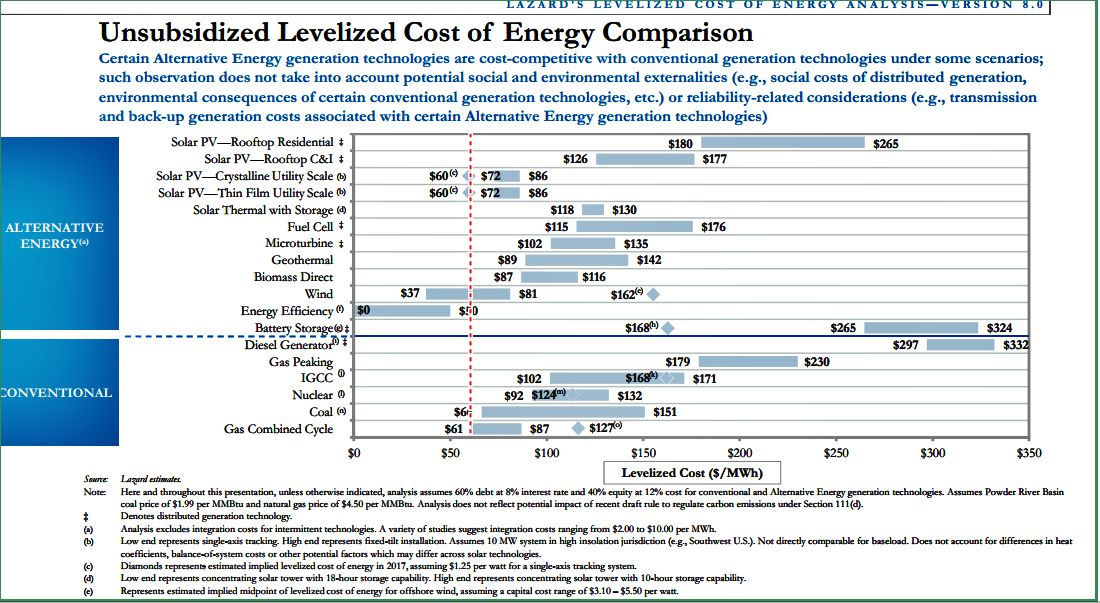
Source: Lazard, Cleantechnica
- Tesla drove storage cost down to 3.4USc/kWh which is set to shrink further to 2.1USc/kWh (as per above calculations)
- Thus, best renewable (intermittent) electricity + best storage gives 3.7 + 3.4 = 7.1USc/kWh set to go down to 6.1USc/kWh.
- This is to contrast with 6.1-8.7USc/kWh for best gas (as per the table above).
In other words intermittent renewable energy + storage is already price competitive with best fossil fuel-based electricity (before any CO2 emission fines/etc). No wonder the industry response to Tesla’s new product has been “Overwhelming. Like, crazy”.
Not the end point
10 year warranty (3,650 cycles) is not the limit. Here is what some of the competitors in the storage space claim:
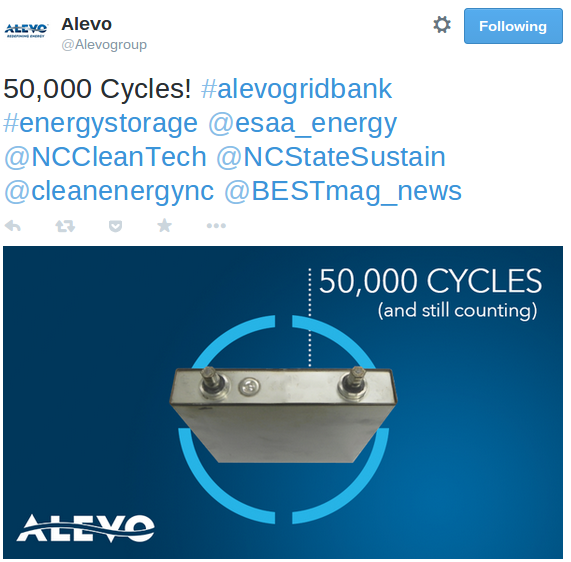
Source: Alevo
With battery duration an order of magnitude better than currently best storage solutions (=Tesla), battery capital costs have limited impact on the overall economics of storage. Especially as the costs are likely to be even less. I personally would be surprised if the best storage technology for the grid applications would be Tesla’s (whose origins and strengths are in the mobile space). Contrary to electric vehicles, optimal storage solution for the grid does not need to be compact. As a result I think that the most appropriate battery technology for the grid may be different from the best storage solution for the EV (as grid battery would trade some size for even lower cost).
It looks like storage has been sorted earlier than even the optimists anticipated.

 Energy, Tech, Macro
It is very informative reading and I somehow trust you calculations better than IEA and other reports. One question that I still feel curious about is comparing levelised costs of production for distributed and centralised generation. You can install solar and battery locally and end user cost in this case is cost of production. For gas turbines end user cost is production plus transmission and distribution. This is a bit back to comparing apples and oranges, but I feel it is a proper price comparison for retail markets.
LikeLike
This is a good question to ask.
Look at the following chart from one of the best experts on technical feasibility of solar/wind (this chart takes California as an example):
http://thesolutionsproject.org/infographic/#ca
An interesting point here is that distributed energy (rooftop PV) accounts for only 7.5+5.5=13% of total. That means 87% is generated centrally, which in turn means that the grid doesn’t go anywhere. Centralised grid is a part of today’s energy layout as well as of the future’s. As such we need to speak separately about the economics of distributed and centralised energy.
Economics of centralised energy (80%+ of the market).
For centralised energy we can compare wholesale market prices, as delivery through the grid costs are the same for gas-based electricity and solar electricity. This is the comparison I make in the post: 7.1USc/kWh for wind+storage at present, set to go down to 6.1USc/kWh after battery gigafactory is completed vs. 6.1-8.7USc/kWh for best gas. So at the industrial scale (the largest energy market slice now and in the future) the cost parity between intermittent+storage vs. traditional power has already been reached.
Economics of distributed energy (20%- of the future market).
For distributed energy the end user cost is not a function of the wholesale market price, but there are other peculiarities:
– The user doesn’t have to pay the grid costs which is one of the biggest attractions of the distributed generation.
– But the costs of PV panels are high (compared to industrial applications) because of the higher overhead costs per unit of capacity (as overhead costs are spread over smaller capacity installed).
– Storage costs are higher for the same reason (350$/kWh of battery capacity (Tesla’s home battery) vs. 250$/kWh for industrial scale) + the cost of inverter.
The end result for the consumer will be 18-26.5USc/kWh implied electricity price (as per the Lazard’s chart) + cost of storage of 4.8USc/kWh (40% higher than in my calculation for the industrial applications) = 22.8-31.3USc/kWh.
This figure, while not outstanding, is comparable with current end user prices in certain locations. My own feeling is that Lazard’s estimates for the costs of rooftop solar (as per the table) are too conservative, and the resultant figure should be lower than that. It probably deserves a separate investigation, but it will not change the overall answer for the market (which will remain 80%+ centralised, and for which the cost competitiveness of solar/wind+storage is already established)
LikeLike