
Below is an attempt to investigate the developments in the Smart Home space from the economic point of view, not from the IT point of view. Is one possible without the other? I don’t know.
Home
This is what our homes looked yesterday. A number of home electric appliances are connected to the electrical central grid. In addition, in many countries homes are connected to the gas grid that feeds home heat generating boilers. (In other places like Russia and some Northern European countries heat is delivered centrally).
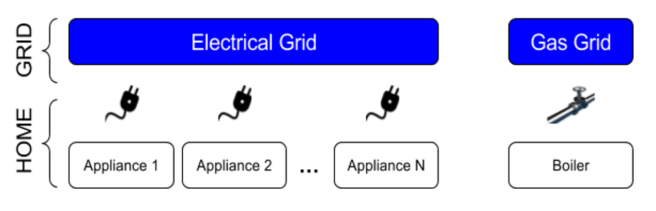
Smart Home 1.0: smart devices
Today those appliances are getting ‘smart’.
- They become interactive with the environment: start reading information about the external environment through sensors, process it, and change mode of operation if needed.
- They become interactive with the humans: normally through a mobile app or web interface.
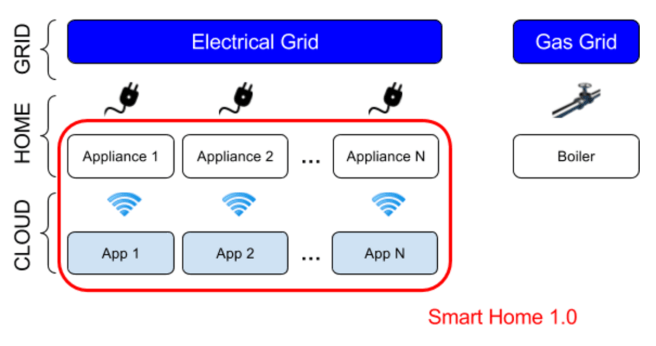
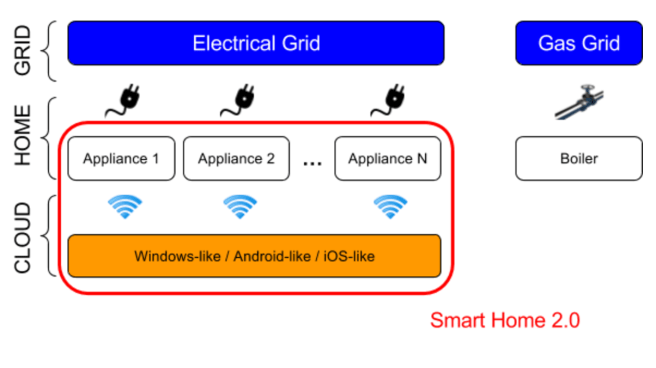
Smart Home 2.0: smart devices => smart platform
Now, this is where the battle is unfolding. A number of companies try to unify standalone smart devices into a single standardised smart platform. The prize is huge and the contenders are many including the all familiar names.
- A commercial product, Microsoft Windows, has become such a platform of choice for personal computers three decades ago. Establishing itself as a dominant solution proved to be a great financial success, so there is little surprise that Microsoft is trying to replicate the same approach for the Smart Home with its HomeOS operating system, aiming to keep dominance at software platform level and inviting hardware partners to “speak” its language.
- Apple’s dominance stems from excellence in original hardware products. Its proposed Smart Home solution HomeKit aims at maintaining exactly that – the highest quality of the constituent pieces / appliances produced by third parties.
- Google’s approach has been different. It has promoted its free open source operating system (Android), enabling competition among hardware producers. Costs slumped. Similar approach is now being tested with its Smart Home open source platform Brillo (simplified version of Android for the Internet of Things era).
Essentially, in the Smart Home space, the majors continue on the strategies that served them well in the past. But the differences between the three are less pronounced.
Platform company economics
If Oscars were awarded to businesses the most prestigious category would be for superior consistent performance, where superiority would be measured as excess return over the cost of capital employed. Most of the businesses around generate average returns that are prone to cycles, only few could be shortlisted for the category.
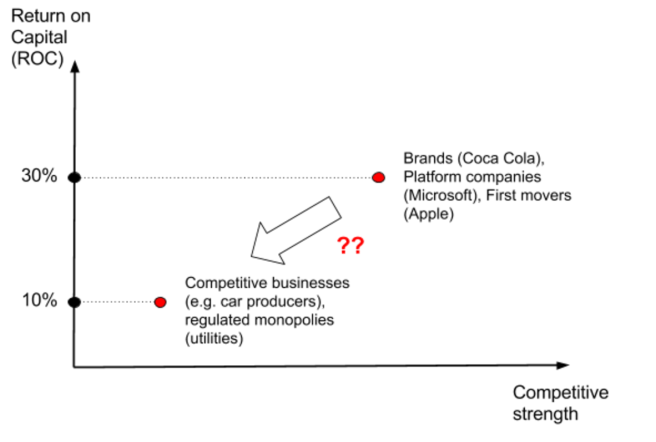
It takes time to check consistency. Coca Cola has been around for 100+ years and its return on employed capital is still in the premium range. Branded consumer products proved to be one of the most successful business models in history.
Many successful companies demonstrate superior profitability at the early stage of their development, but few can sustain it for the long term. Over the last couple of decades information technologies sector produced such an early breed of winners, including the giant ones. Are these the new sustainable coca colas?
For the purposes of Smart Home analysis we need to compare two IT paradigms – commercial, closed platforms vs. free, open source platforms. Each expresses its differences from the other in multiple ways.
| Closed platforms / standards | Open platforms / standards |
| Windows (Microsoft), iOS (Apple) | Linux, Chrome OS / Android (Google) |
| Customised plug (Apple) | Standard micro-USB |
| Silverlight, Adobe Flash | HTML 5 |
| … | … |
(My IT friends would easily extend the list)
Microsoft is a current member of the “30% ROC” club through selling proprietary software. Apple is also a member through selling quality hardware. Google, seeing opportunity in both, taps the area via promoting free open source IT infrastructure (Android), enabling competition among hardware manufacturers, and, probably, aiming at becoming a member through the resultant higher traffic monetisation.
Here is what the ongoing developments look like:
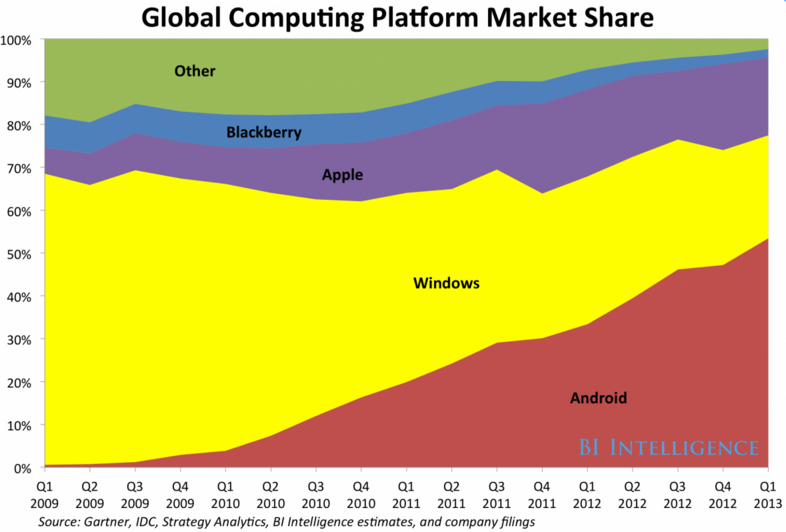

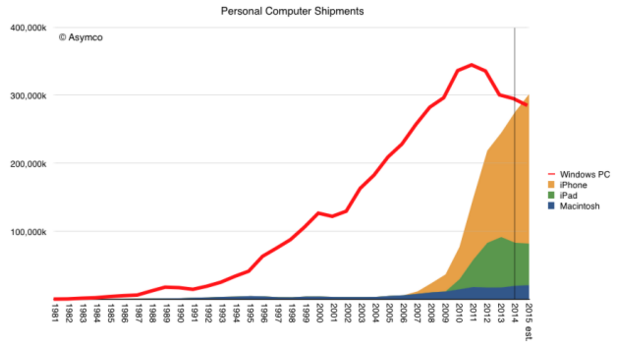
Or in short:
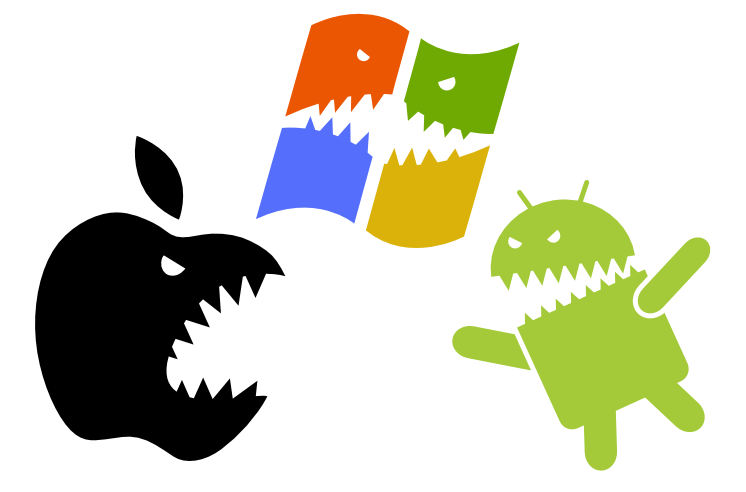
Such battles don’t bode well for staying in the “30% ROC” club. More so, to the best of my knowledge, neither Microsoft nor Apple offer a Smart Product solution that is way ahead of competition. This is not how the two companies made their names in the first place, and as such it seems like Smart Home is set to be a competitive environment centered around a free open source platform (that is yet to establish itself as a leader in this space) . Or does it?
Smart Home 3.0: smart devices, again
So far boilers stayed aside on the diagrams above, but these devices are also becoming part of Smart Home though in a special way. Smart boiler is not just one that communicates and interacts (like other smart appliances). Instead smart boilers operate under different physical principles. While conventional boilers efficiently burn gas into heat, new generation smart boilers convert gas into heat AND electricity. The physical principles of this technology have been known for a long time (Combined Heat and Power, CHP), but it has never been implemented at home scale until now. Today new generation CHP-boilers produce as much high-grade by-product electricity, that it is worth more than the cost of the CHP-boiler itself.
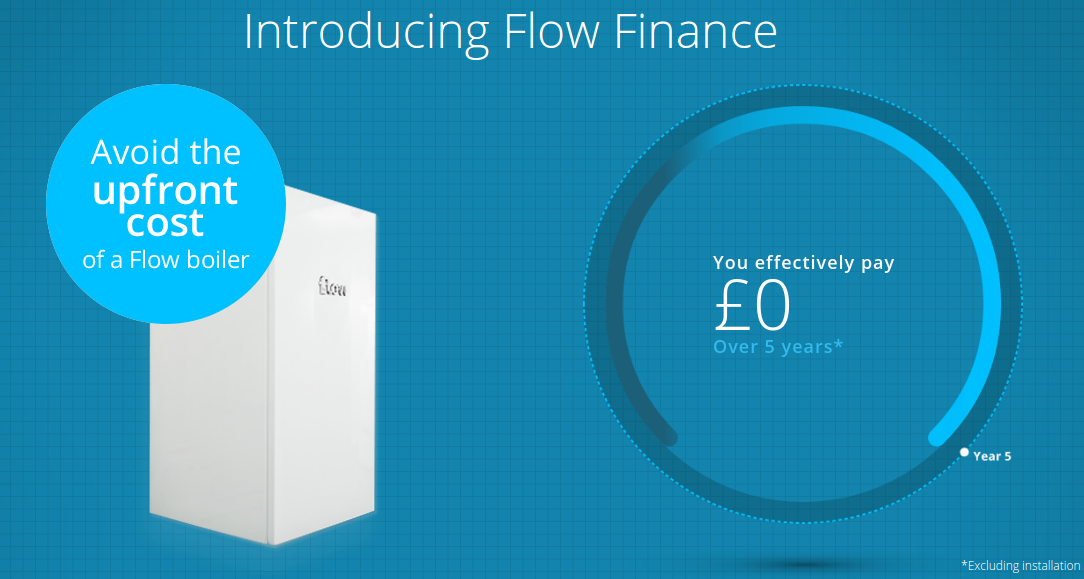
CHP-boiler is becoming an in-house electricity source exploiting a structural price difference between gas and electricity.
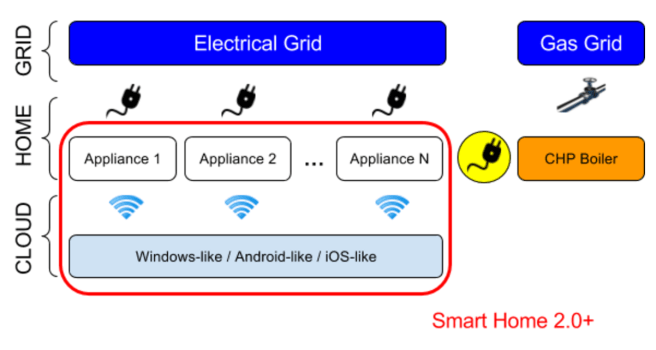
This new entrant into the Smart Home layout changes the logic of the system quite a bit. CHP-boiler produces electricity according to its heating cycles; whereas, washing machine, for example, can be programmed to run at the times when grid electricity is the cheapest. If electricity is now produced in-house as a by-product (that is naturally the cheapest) the logic demands that the two devices coordinate their cycles of operation. This is where the system needs to become truly smart!
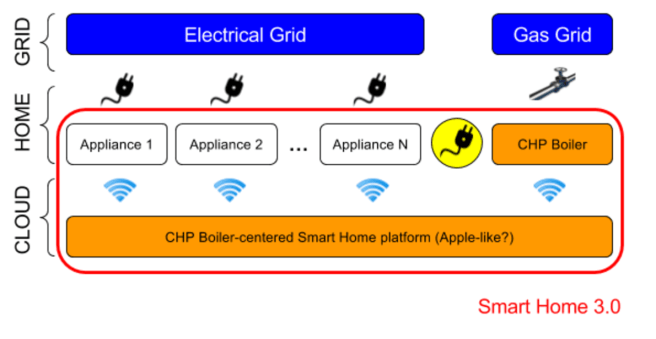
Some new smart devices can be thought of apriori (like CHP-boilers), others will become obvious only after they have seized the world. Will there be iphones of the Smart Home, and new entrants enjoying their “iphone-moment”?
If new, unique, smart devices play any significant role in the Smart Home space, the prevailing Smart Home platform can be expected to grow around such devices (as it was the case with the whole ecosystem grown around iPhone). Will it be an open source system, or the one picked by the winning smart device producers, remains to be seen.

 Energy, Tech, Macro
Very good, working on something similar
LikeLike