
Macro meets Tech
The past 10 years have seen the maturation and eventual bursting of the market bubble, followed by a financial crisis, which led to an economic recession widely perceived to be still ongoing. The unprecedented amount of economic stimulus on both the monetary and fiscal sides, produced what many see as a less than satisfying outcome – with reported economic growth well below historical levels, inflation uncomfortably bordering on deflation, and a slow recovery in unemployment levels. Slow progress has brought back the notion of secular stagnation – a condition of long term suppressed demand, resulting in subdued economic growth – postulating economic recession as the new ‘norm’.
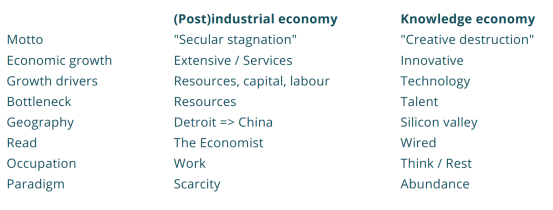
There is an alternative explanation. The leading economies are now undergoing a transition from the two century old economic model based on capital, to an economic model driven primarily by technology. The economies growing via the likes of Google, as opposed to the likes of Ford, will have new economic characteristics, respond differently to traditional economic stimuli, and will have left unconventional traces puzzling the macroeconomic statisticians. Statistical metrics designed during industrialisation are ill-equipped to indicate structural changes, resulting in the ongoing “creative destruction” commonly misdiagnosed as “secular stagnation”.
The emerging economic model is characterised by knowledge and technology as being the new primary production factors, with technology-driven deflating costs and prices, lower capital intensity, and structural surplus of labour and capital. The epicentre of this change is Mountain View and Palo Alto, now replacing Detroit and New York, with its economics better illustrated in ‘Wired’ than in ‘The Economist’.
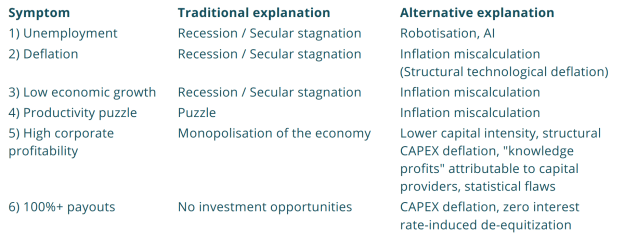
In what follows we discuss the economic symptoms most typically associated with ‘secular stagnation’ through the emerging Knowledge Economy perspective.
Symptom 1: Unemployment
Unemployment rate recovery is slow on both sides of the Atlantic. In Europe the most recent reading is 8.3% (Oct 2016) – still 1.5 percentage points higher than before the crisis. In the US the official unemployment rate (4.6% in Nov 2016) has already reached the pre-crisis levels. Part of this recovery though exists only on paper as the official US unemployment statistics does not take into account the longer term discouraged workers.
Figure 1. Unemployment in the US and Europe (Source: Trading Economics)
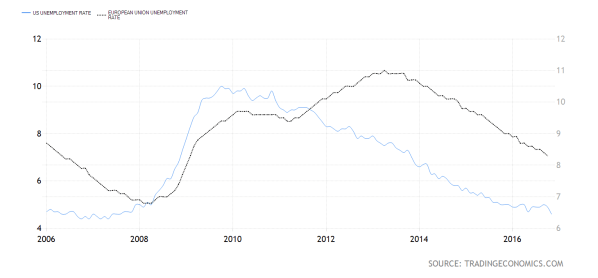
Figure 2. Adjusted unemployment rate dynamics in the US (Source: Shadow Government Statistics)
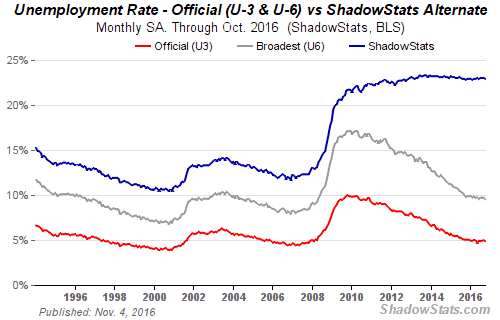
Traditionally high unemployment is a reflection of low demand in the economy, and is an essential feature of economic recessions. As the ongoing unemployment rate normalisation is slow the recession is dubbed secular highlighting its longer than usual duration but not explaining the nature of slow recovery.
An alternative view is that current unemployment has a structural nature. With the progress in robotisation of the manufacturing process, and, more recently, in development of Artificial Intelligence, the economy may have reached the stage that John Keynes called technological unemployment – “unemployment due to our discovery of means of economising the use of labour outrunning the pace at which we can find new uses for labour”. Ever since the industrial revolution humans have been contributing less physical work into the economic value chain and more brain work. In terms of labour productivity the shift has been extraordinary beneficial for humans. But as at present the brain itself becomes a subject of technological replication what happens to the man’s place in the economic value chain?
Apple is moving from “designed in California, assembled in China” back to “designed in California, assembled in USA” not to fulfill president-elect Trump promises, but because it is not much of the (expensive) labour required in the modern production processes. Tesla is building new factories in the US aiming to bring Star Wars C-3PO’s “machines making machines”-nightmare into life. Artificial Intelligence-enabled self-driving cars and Artificial Intelligence-enabled no checkout shops are going to leave millions of drivers and cashiers out of work. The emerging technological unemployment trend could be at its very beginning.
Symptom 2: Deflation
The dangers of deflation have been well understood since the Great Depression. Irving Fisher described how the deflationary spiral increases the real value of the corporate debt, making companies focus on repairing debt at the expense of investment activities, thus reducing investment demand, which has a negative effect on the real side of the economy and adds more to deflation. Ever since the central banks used the monetary policy tools to combat deflation whenever it was required.
After the 2008 crisis the interest rates have come close to zero, first in the US then in Europe, reinforced by quantitative easing at later stage, none of which though had much of a desired impact. Not only did the real economy seem not to respond to the stimulus, but inflation also hovered dangerously close to the deflationary territory. A traditional explanation is that the recession was so drastic that even an unprecedented doze of monetary stimulus was not enough to get things back to normal even on the nominal side of the things.
An alternative view is that we live in the world of structural technology-driven deflation, the one that has nothing to do with the deflationary spiral from almost a hundred years ago. Hal Varian, Google’s chief economist, provides a valuable example. In 2000 80 billion photos were taken annually at a cost of 50 cents each. In 2015 it was 1.6 trillion photos annually (20x more) at a cost of effectively zero as the photo industry moved from film to digital.
As technology increasingly disrupts the traditional industries deflationary pressures spread around and get reflected in such macroeconomic indicators as inflation. Meanwhile the monetary authorities charge when they see too low reported inflation fighting the battles of the past.
Symptom 3: Low economic growth
Despite technology-driven deflation having an impact on reported inflation, its full scale is severely underestimated in the official macroeconomic statistics, resulting in more statistical distortions.
Let’s continue with the example above. With digital replacing film, and number of photos taken growing 20x, what should be the impact on real GDP? In the spirit of calculating real GDP dynamics in constant prices, one would assume that the photo industry’s contribution to GDP grew from 40 billion USD to 800 billion USD (in 2000 dollars). In reality the official statistics reported a fall in real GDP as cameras were absorbed into smartphones. A purely nominal development – price deflation of a particular product – is recorded as negative real effect on GDP, as opposed to a negative nominal one. The official macroeconomic statistics fails to properly split the overall economic performance into nominal and real.
Thus, actual inflation is even lower than officially reported, and actual real GDP growth is higher than reported. But unlike in the past, higher actual real GDP growth has come not through the higher quantities of cameras and films produced, but through higher purchasing power of the currency buying into the new replacement products.
Symptom 4: Productivity puzzle
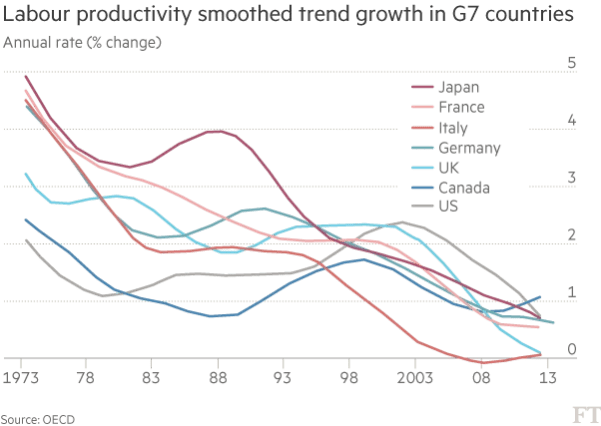
Labor productivity, as measured by output per hour, grew for decades reflecting technological progress. But the trend slowed down even before the financial crisis or secular stagnation talks. Some people believe that the most recent technological breakthroughs are simply not comparable to those of the past – an explanation consistent with the secular stagnation view of the world. But the same nominal-real distortion, that in this case understates the numerator of the labour productivity ratio, provides an equally plausible explanation.
Figure 3. Labour productivity dynamics (Source: Financial Times)
Symptom 5: High corporate profitability
One unusual characteristic of the ongoing “recession” is high corporate profitability. The US companies’ profits as percentage of GDP are high, free cash flow and return on capital are close to all time highs, and the proportion of companies generating more than 50% return on capital has grown manyfold reaching almost 20%.
Figure 4. Profitability of the US companies (Source: The Economist)
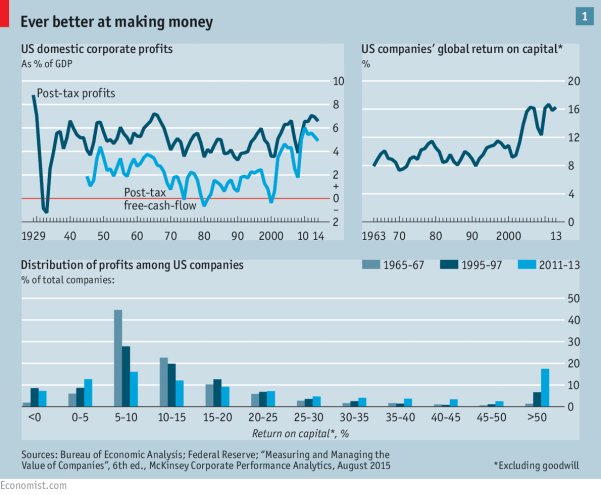
A view consistent with the secular stagnation hypothesis and accepted by some of its proponents suggests increasing monopolisation of the corporate America. But the same trends can be seen as natural consequences of the emerging Knowledge economy basic principles.
The main production factor in the emerging economic model is shifting from capital to technology resulting in the new ventures being less capital intensive. As successful new ventures grow market share and change the industry mix, the aggregate capital expenditures trend down and free cash flow trends up. Unlike labor or capital technology is not an independent production factor. It is created within the enterprises and ultimately benefits the corporate owners (original capital providers). Thus reported profits and return on capital trend up. Similarly, an increasing share of the 50%+ return on capital companies is an indication that the economy is growing via capital light businesses, creating the new niches and pushing old players out of the traditional ones, rather than a sign of price manipulation and monopolisation.
Statistical mismeasurements play a role here as well. As Hal Varian points out one of the deficiencies of the existing GDP calculation methodology is that it was designed for a single country, and fails to properly reflect the actual economics of multi-country production chains. “Designed in California, assembled in China” iPhone contributes to Apple’s corporate profits, to China GDP (export from China to elsewhere), but not to the US GDP. Thus any profitability-to-GDP ratios for production outsourcing countries are overstated as such ratios properly account for the numerator, but underestimate the denominator.
Symptom 6: 100%+ dividend payouts
2016 is expected to be the third year in a row when the US companies pay back, in the form of dividends and share buybacks, more than they earn.
Figure 5. Paybacks are 100%+ three years in a row (Source: Zero Hedge, Barclays)
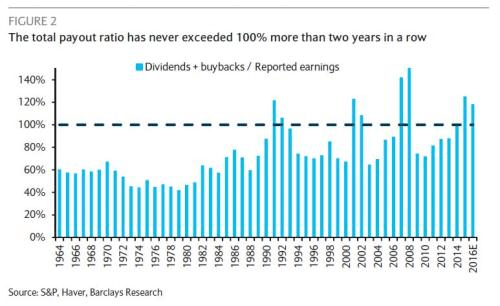
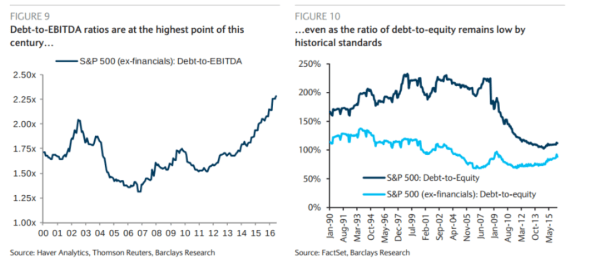
The ongoing decapitalisation could be interpreted as a sign of few available reinvestment opportunities thus supporting a secular stagnation argument. But there is another explanation. In the emerging Knowledge economy technology-driven deflation puts a downward pressure on capital expenditures. In addition policy-induced near zero interest rates have caused a shift in the corporate capital structures away from more expensive equity to cheaper debt. Both trends combined have resulted in ever higher proportion of earnings returned to the shareholders.
Figure 6. Corporate capital structure shifts from equity to debt. (Source: ValueWalk, Barclays)
Secular stagnation, or creative destruction?

 Energy, Tech, Macro